
I love to collect quotes. In fact, I keep a running list of them in my Notes app…particularly ones that capture wisdom and truth, and that are inspiring. As I began writing this piece, a quote by Maya Angelou came to mind. She says:
“My mission in life is not merely to survive, but to thrive; and to do so with some passion, some compassion, some humor, and some style.” — Maya Angelou
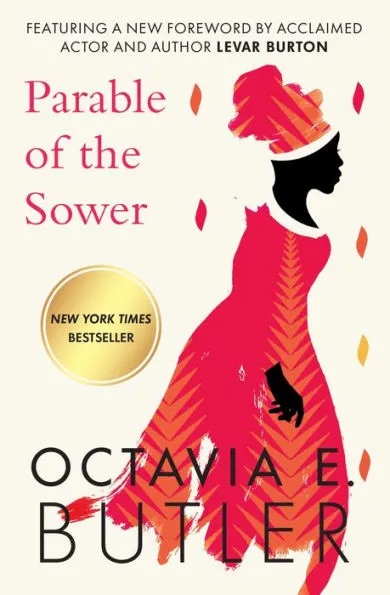
Thriving is how I want to live my life. But recently, and particularly after reading Octavia Butler’s novel Parable of the Sower, I’ve been wondering if we’ll soon be living in a time where surviving is all we can hope to do.
Published in 1993, Parable of the Sower is a science-fiction, dystopian novel. It takes place in a future California where the cost of living is exorbitant. In this world, jobs are scarce, and even those who are employed are not able to earn a living wage. Global warming exists here, causing frequent droughts and wildfires. Moreover, many people are addicted to a particularly destructive drug, literacy is a rare skill, and increased militarization is the chosen response to rampant violence. Any of this sound familiar?
The society Butler envisions in Parable of the Sower strongly resembles our current, lived one. So as I was reading and imagining what I would need to survive as a character in the novel, I soon realized that I was actually asking what I need to survive the world we’re now living in, as well as the future one we’re shaping.
The thing is, regardless of what state the world is in, what we need to survive is the same. We need food, water, shelter, clothing, and air. I would also add community to this list (although others may see community as a need for thriving, not surviving). A saved person might say Jesus. Point being, needing all of these to survive, doesn’t change with circumstance. What does change is how accessible these resources are… and consequently, what we’d need to do to get them. In other words, our survival really depends on us taking action and using the necessary skill(s) to gather these resources. So while the question seems to implicitly ask what things we need to survive, the more pertinent one, is what skills do we need?
Parable of the Sower offers several ideas, but I’m going to focus on one: literacy. After one of the characters ventures to live out on depraved streets, we learn that his ability to survive boils down to the fact that:
“…[he] can read and write…and none of [the others on the street] can.” — Parable of the Sower
Without greater context, I know this quote seems rather uninteresting. But understand that after being taken in by a street gang, this character literally earns a living by being literate! He is not paid money for his ability to read and write. Instead, he is compensated with the ability to exist…with his own life, while others’ are considered dispensable. While it’s frightening to imagine a world like this where literacy is such a rare and invaluable skill, I unfortunately don’t think the idea is so far-fetched. I’m truly concerned as I see signs of today’s society become increasingly illiterate. But even more, my fear comes from my experience living overseas as a functionally illiterate adult and learning how costly illiteracy can be. So let me explain.
I played my first overseas, professional basketball season in Israel, where Hebrew is the country’s official language. This was my first experience living in a country where I didn’t speak or understand the native tongue, and it is hard to describe the overwhelming feeling of trying to navigate the world when you’re literally at a loss for words. Hebrew isn’t like Spanish or French, where the alphabet is virtually the same as the English one, and where you can identify some words when listening carefully. No. Hebrew is more like Chinese—a whole different set of characters that together, make sounds so foreign to your ear they don’t register. And that’s just taking into account the oral language. Traffic and store signs, menus, and package labels are also written in Hebrew (occasionally with English subscript). This meant that for six months, I was effectively illiterate. Only then, did I realize how much I depended on my ability to read in order to function day to day. And nothing defines this more than my first few trips to the grocery store. I remember staring at the shelves filled with Hebrew packages, wondering “how in the world am I supposed to figure out what’s what?” I would look at the pictures on the packages and try to decipher their difference. “Is this laundry detergent or fabric softener?… What kind of flour is this? Do they have self-rising?…. Is this spinach or basil?” After fighting my decision paralysis, I’d eventually choose an item and hope for the best. I’m sure you can imagine my frustration the day I came home with a bag of basil.
Clearly, this wasn’t a high stakes situation, and as a more seasoned traveler, it’s one that I can now look upon with amusement and fondness. But at the time, I felt so much of the strain, stress, and anxiety of trying to function without being able to read. Without reading, you’re constantly operating with limited information and you end up making more guesses than decisions. It was exhausting living in this endless state of uncertainty and continually second-guessing myself. Beyond that, I often felt embarrassed and self-conscious about not being able to read and in turn, make what should’ve been simple decisions. I worried that people would notice that I couldn’t read and would judge or worse, pity me. Occasionally, I was forced to muster up the courage to ask strangers for help. It was such a relief when these acts of vulnerability were received by someone that 1) understood English and 2) was kind enough to assist me. But even the kindness I received became problematic. You see, illiteracy puts you in an inherently vulnerable position—you’re either dependent on the goodwill of strangers or left guessing and leaving much of life up to change. Perhaps this isn’t so costly in the context of grocery shopping, but when it comes to other activities related to my job and earnings, my health, my rights or my life, illiteracy quickly becomes dangerous.
And so what becomes more frightening than imagining a society like Parable of the Sower’s where most people are living in this vulnerable state, is realizing that I’m already living in a shockingly illiterate society. Today we live in a world where toddlers know how to use phones and tablets, before they know how to speak coherent sentences…let alone read one. For many children, technology is a crutch that incapacitates them from developing critical skills like reading, writing, and communicating in general. Parents and educators are regularly exposed to the depths of our literacy crisis. But as someone who is not around children often, I will never forget the record-scratching moment when I personally got to see that the crisis is REAL.
Two school-aged children were watching YouTube videos on their tablet. Initially I was intrigued to see that each time they input a new video search they used auto dictation—the tech feature that converts the speaker’s words into text. For me, this was one of those insightful “So this is what kids do nowadays?” moments. But my intrigue soon turned into concern as I noticed the children haphazardly clicking through the videos—paying no attention to their titles or descriptions. After seeing them repeat this cycle several times, it became evident that these children weren’t just being lazy and not reading, but they could not read.
Children eventually grow into adults, and in America, 1 in 5 adults are functionally illiterate. This means that they lack the reading and writing skills needed for daily living and employment tasks. Yet, as the saying goes, “Reading is fundamental.” Reading is the key that gives us access to information. It empowers us to live by informed choices, not by chance. Being able to read means that we can maintain our independence and the ability to think and decide matters for ourselves. That is, without being unhealthily influenced, controlled, or at the mercy of someone or something (i.e. technology). Being able to read ensures our freedom. And I don’t mean that figuratively. Illiteracy is highly correlated with incarceration, while literacy creates financial freedom in the form of greater earning power and employment. Ultimately, I don’t see how a person can survive without being free. Yes, technically it is possible. There are millions, living in various forms of bondage that prove this to be true—both in this country and around the world, and presently and historically. But this brings us back to Maya Angelou’s quote. It is extremely hard for me to imagine a life merely surviving. For the life I want to live, surviving is synonymous with thriving. Aside from needing the basic food, water, shelter, clothing, air, community and Jesus, thriving requires us to be free. And in so many ways, it’s clear to me that illiteracy is the lock, while literacy is the key.
What’s On Your Mind?
Someone once said you can tell a lot about what’s on a person’s mind by the questions they ask. So here’s what’s (still) on my mind:
Creative destruction is not a new phenomenon. Historically, we’ve seen new technology replace older ones, and make certain skills, industries, and livelihoods obsolete. Traditionally, this “destruction” has targeted more manual and physical activities. Is this the first time that intellectual skills are impacted by innovation? Is there a particular catalyst that will force us to protect and/or restore any of these skills?
What are your thoughts? Comment below!

 Rooted Reflections
Leave a comment