

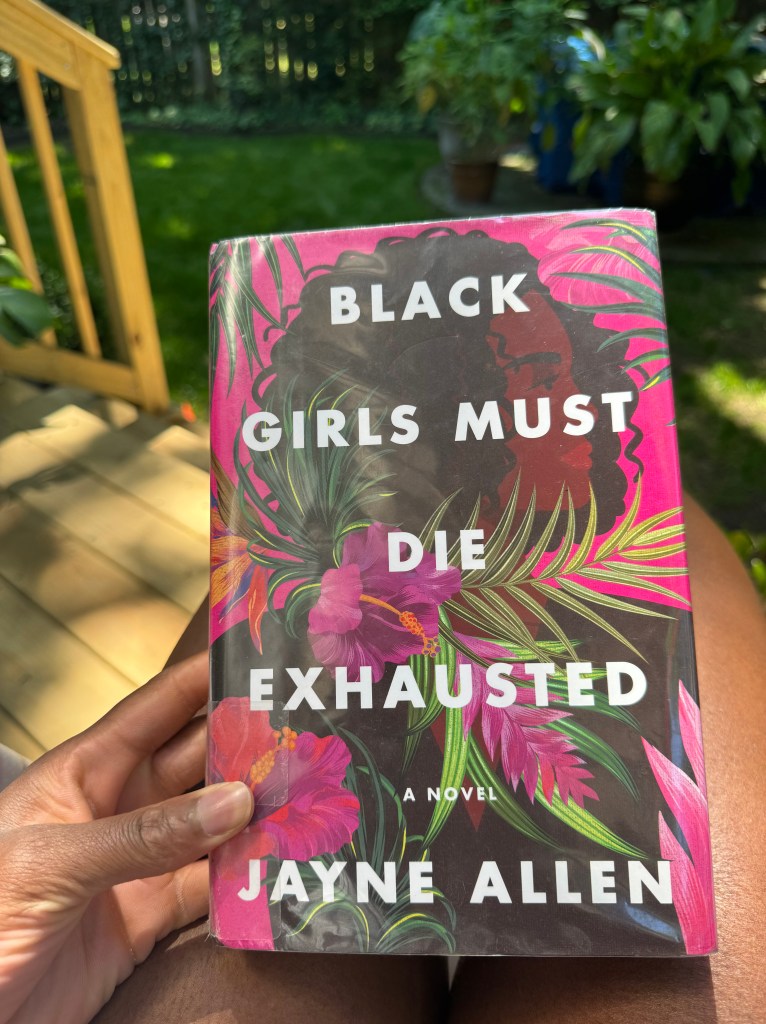
I recently read the novel Black Girls Must Die Exhausted by Jayne Allen—a book that I would categorize as an “of-age story.” While the “coming-of-age” story recounts a character’s journey from childhood into adulthood, the “of-age story” is one that portrays young adults transitioning further into adulthood…growing into more seasoned, mature people. I’m not sure if this is a new, growing genre of literature, or if it’s just new to me now that I am of age and can appreciate the storylines. But I quickly latched onto Black Girls Must Die Exhausted because it spoke, honestly, to this stage of life that I currently find myself in. The novel covers the life-altering decisions we continually make as adults, the grind of adulthood, the reality that time is finite, the uncertainty, and new freedom that’s paired with growing responsibility. Of course there is also plenty of fun, joy, adventure, excitement and success to be had. But more often than I’d like, adulthood feels…well, exhausting.
In so many moments when flipping through Black Girls Must Die Exhausted, I found myself having visceral and often audible reactions to the words on the page. Yes, I am admittedly that reader. I will laugh out loud at a character’s quirks and quips; I will suck my teeth when a character starts to piss me off; and I will “Mmm” when I’m challenged with a new perspective to think about. One quote in particular that captured me reads:
“My daddy said to me as soon as my little boobies started to sprout and those boys came sniffin’ around, ‘Now Gretchen, a man that ain’t got no plan for you ain’t no man at all. And he’s definitely not your man, you hear? Real men got plans for the things important to them. If he ain’t got no plan for you, then you ain’t what’s important.’ And I never forgot that.”
It seems that every time I read this quote, I can’t help but “Mmm.” And it’s not just the wisdom and perceptiveness of the quote that strikes me. It’s the fact that although in this scene, these words were spoken by a woman, they originally came from a man. More specifically, her father. In matters of relationships and dating, women are regularly consulted by other women. We confide in and hear from our mothers, aunts, sisters, and girlfriends. Comparatively, we have far fewer conversations with the men in our lives. Yet, they’re the ones we’re often in relationship with! So I began to wonder: What other dating advice do fathers (or father-figures) give their daughters? And how common is it for women to get this advice? Before writing this piece, I reflected on my own father’s advice to me, and decided to ask a few others about the dating advice they give their daughters. Here are the key takeaways from those conversations:
By and large, the fathers agreed with the quote “Real men got plans for the things important to them. If he ain’t got no plan for you, then you ain’t what’s important.” They did make note of a few caveats though. First, and maybe most obviously, the quote doesn’t hold the same weight after one first date, as it does after one year in a relationship. It becomes truer as more time elapses and the relationship is more firmly established. Second, while it is understood that men often dictate the pace, level of commitment and future of a relationship (ex. By asking one to be their girlfriend or proposing for marriage), men are not solely in control or responsible for this. The quote also applies to women who have agency and thus should be active participants and decision makers in the relationship. Just as the man has to think about his future and decide if his partner fits into that, we also have to consider our future and decide if our partner fits. Regardless of the answer, it demands a conversation. Simply seeing yourselves together in the future doesn’t mean much if one partner’s vision and expectations don’t align with the other’s. For example, a woman may envision herself as a stay at home mom that supports her husband and family, but her partner may envision them as a power couple climbing the corporate ladder together. In this instance, there may have been a plan to be together, but without more in-depth conversation, somebody’s going to be sorely disappointed.
Beyond expounding upon the quote, the rest of the fathers’ advice can be categorized into five key points.
1. Before dating, take time to develop a strong and secure sense of self. And while dating, stay true to yourself.
Know and learn to be accepting of who you are— your beliefs (religious, political, etc.), values, interests, insecurities, and more. You don’t need, and probably don’t want to be in a relationship with someone who is just like you. But despite individual differences, you and your partner need to be compatible. You also need to make sure that you have respect for each other and your differences. Just because you’re in a relationship, doesn’t mean you stop being an individual. Your differences may require compromise but don’t allow yourself to be controlled or changed in ways that pull you away from who you are at your core.
2. Have standards and know that you don’t have to settle for someone who doesn’t meet them.
Develop a standard for how you want to be treated in a relationship, and the values and qualities your partner must have. For example, is he chivalrous? Well-mannered and respectful? Honest and trustworthy? A leader? Articulate and able to communicate? As you develop your standards and criteria, avoid being superficial, but don’t stop being practical. For example, your decision over whether or not to entertain a man shouldn’t be based on the size of his wallet, but you do need to make sure that he at least has a wallet. Ensure that he is employable, financially responsible and able to take care of himself. Many of the standards and criteria you list, will ultimately boil down to one thing that unequivocally needs to be in a partner: maturity.
3. Find a man that is mature.
There’s the cultural narrative that men are late bloomers compared to women. However, there comes a point where boys have to man up… and hopefully, this happens before you find yourself in a relationship with him. Before diving deep, make sure the man understands responsibility and doesn’t shrink or shy away from it. Realize that not only do people make plans for the things important to them, but they also tend to prioritize the things important to them. Know that he is clear on his priorities, and ultimately ready and willing to make you one of them. You come before him hanging out with the “boys” or his video games. If you’re unsure of someone’s values or priorities, you can easily get a snapshot of this by looking at where they choose to invest their time, money and attention, and also how much of it they choose to give. And yes, it is a choice.
4. Flowers are cheap.
If you’ve ever gone to a florist to buy a bouquet, you know they’re actually not that cheap. But the point is, flowers are cheaper and easier to come by than changed behavior. If you find yourself in a cycle where your partner repeatedly makes a mistake or offends you, only to turn around and apologize without ever correcting the underlying behavior, know that you don’t have to accept this. You should value yourself as someone deserving more than lip service and sweet gestures. Expect action or changed behavior and hold your partner accountable to that. Relatedly, “as soon as you come to realize that someone is a bullshitter, cut them off…immediately.” (And that’s a direct quote.) It is okay (and sometimes necessary) to cut ties with a person and/or break up a relationship.
5. Find someone you would be proud of to have as a husband, and not ashamed to bring around your parents, family, friends, or anyone else.
It’s as simple as that.
The dating advice shared by the fathers wasn’t earth-shattering. In so many different words, they’re things that I’d already been told by women in my life. Curious as to whether some of these womens’ wisdom could be traced back to the caring men in their lives, I asked some women what dating advice they remembered receiving from their fathers (including father-figures). Several were hard pressed to recall any specific conversation or fatherly advice about dating. That is, beyond warnings to be respectable women and remain chaste. But the women also gave their fathers credit by recognizing that just because words weren’t exchanged, that doesn’t mean advice wasn’t given. Love is a verb, and as such, perhaps the best advice that fathers gave, was imparted through his loving actions—how he carried himself and cared for them (i.e. the daughters), the mothers, and other women in his life. A father’s actions tell us a lot about the qualities we should look for and expect in a man. Oftentimes they also set the standard for how we want to be treated. It is important to acknowledge that not every father/man has healthy interaction or relationship with the women in his life. As such, not all fathers/ men deserve to be the standard we model our lives after. But whether good or bad, what is modeled for us, becomes a powerful influence over us.
At the end of the day, no advice, whether from a woman or man, verbal or nonverbal, is foolproof. Advice is just that…”advice.” Something to be considered, but not necessarily acted upon. In reading Black Girls Must Die Exhausted I realized how rare it is for us to receive dating advice from the men in our lives. And after speaking to fathers, it became evident that they have plenty of insight to share. Granted, not every point is radically different from what women have already told us, but sometimes, even hearing the same tune in a slightly different tenor may cause the point to land differently. And for me, that was incredibly valuable.
What’s On Your Mind?
Someone once said you can tell a lot about what’s on a person’s mind by the questions they ask. So here’s what’s (still) on my mind:
- How, if at all, would the dating advice that fathers give their sons, differ from the advice they give to their daughters?
- As we’ve established, though valuable, it‘s not common for daughters/women to receive dating advice from their fathers/men in their lives. Is it just as rare for sons/men to receive dating advice from their mothers/women?
- Single-parent, specifically mother-led, households are common. How does this family structure (i.e. not having a father present), impact the children of the family once they begin dating and pursuing relationships?
What are your thoughts?




 Rooted Reflections
Leave a comment